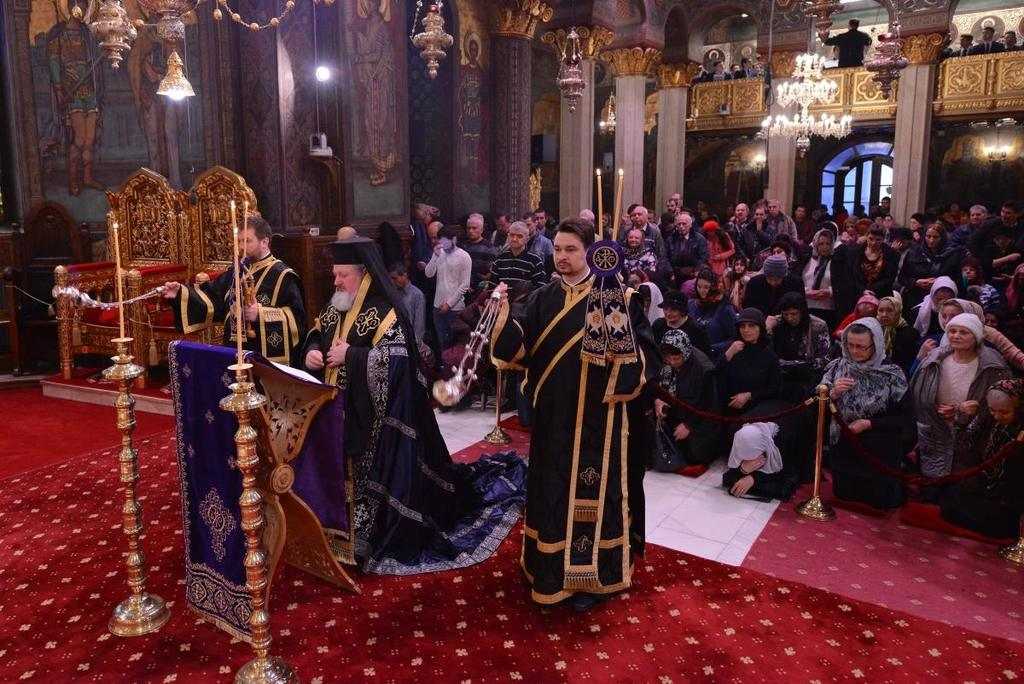
Tuesday, 15 March 2016, His Grace Varlaam Ploieşteanul, Assistant Bishop to the Patriarch, celebrated, at the Patriarchal Cathedral, the second part of the Canon of Saint Andrew of Crete, within the Great Compline.
His Grace explained, in the sermon addressed to the faithful, the meaning of the Bible text read and showed that “the Gospel text of this night mentions mercy and prayer, namely that we must do them not like the hypocrites in front of the people to be praised by them”. In this case, the people’s praise means “the only reward that we receive”, and this is why we must do good deeds “secretly, so that our Father, the God in Heaven Who sees everything that is secret may reward us”. The hierarch has also spoken about prayer underlining the fact that “a temptation of modernity is to think that we can pray at home, which is quite true, but we must pray first of all together in the church of God”. While referring to the present liturgical period, His Grace said that “Lent is a period in which we try to restore, through deeds of justice and all spiritual efforts, our communion with God, broken by the sins committed”. “Lent is also an occasion to cultivate communion with one’s fellow beings, as we know that all of us make together the ʼBody of Christʼ, as Saint Paul the Apostle so nicely calls the Church”.
In the end, His Grace Varlaam Ploieşteanul told the faithful that “the Gospel text of this night is an urge to defeat the passion of self-pride and ask for the forgiveness of all those whom we wronged, offering forgiveness in our turn, and praying all to God to forgive us”.
Partially read during the four days of the first week of Lent and completely on the Thursday of the fifth week, the Great Canon becomes a guide for our life, due to the elevating thoughts transmitted, to the themes needed in the life of every human being (humbleness, repentance, chastening of the heart), as well as to its depth. The content of the Great Canon is a spiritual one, a deep dialogue of the sinful man with one’s own conscience, which draws the attention to the acts committed. One can notice the alternation between two plans: the sinful soul which deplores its own sins because it has not taken the way of the righteous, but the long way of the mistake which cries in the depth of one’s heart: Forgive me! I sinned before heaven and You! The content of the Great Canon is a spiritual one, a deep dialogue of the sinful man with his own conscience, which draws his attention to what he has done. One can notice the alternation of the two plans: the sinful soul which deplores one own sins when one did not follow the way of the righteous, but the long way of confusion which cries from the bottom of one own heart: Forgive me! I sinned before heaven and before You!, and that of the human beings who have reached deification through repentance.