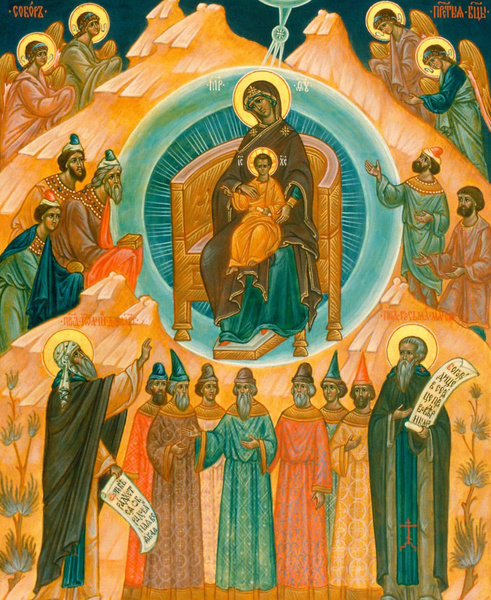
Synaxis of the Most Holy Mother of God
On the second day of the Feast of the Nativity of our Lord Jesus Christ, the Church has established the celebration of the Synaxis of the Most Holy Mother of God. The name of today’s festival signifies the gathering of the faithful in order to praise and glorify the All-Holy Virgin, who gave birth to our Savior.
On the first day of the Nativity of the Lord, the Church glorifies the Redeemer of the human race, and the blessed deliverance which freed the sinful world from the snares of the Enemy. On the second day of the Nativity of the Lord, which was such a great event for our salvation, the Church calls upon us to honor the Ever-Virgin Mary, the Mother of our Lord, in an appropriate manner.
The day after many of the Church’s Feast Days is called the Synaxis – such as the day after the Nativity of the Theotokos, when the righteous Joachim and Anna are commemorated; or the day following the Feast of Theophany, when we honor Saint John the Baptist, etc.
The Feast of the Synaxis of the Mother of God dates back to very ancient times. In the IV century, some Holy Fathers, such as Saint Epiphanios of Cyprus (May 12), were already preaching about it.
In the ancient Menaia, the Feast of the Synaxis of the Most Holy Theotokos was called “the Nativity Gifts.” This refers to the gifts which the Magi from the East brought to the newborn King of the Jews – the Divine Child Jesus. The Feast of the Synaxis of the Mother of God was also called “the Flight into Egypt.”
On December 26, the early Church commemorated the Wise Men who came to worship the Savior, and the flight into Egypt, as well as the Synaxis of the Mother of God. That is why some icons of the Nativity of the Lord depict His Birth, the worship of the shepherds and the Magi, as well as the Flight into Egypt. Sometimes the inscription reads “The Synaxis of the Most Holy Theotokos.”
Now, however, we commemorate “the Adoration of the Magi: Melchior, Gaspar, and Balthasar, and also the shepherds in Bethlehem who were watching their flocks and came to see the Lord” on the first day of the Nativity (December 25), but the Flight into Egypt is commemorated separately on December 26, the second day of the Nativity.
Before the massacre of the 14,000 Holy Innocents (December 29), an Angel warned Saint Joseph to take the Child and His Mother and flee to Egypt and to remain there until the Angel brought him word that it was safe for him to return to Nazareth, “for Herod will seek the child to destroy him” (Matthew 2:13).
In the icon of the Flight into Egypt there are mountains. The Virgin sits on a donkey with her Child, looking back at Joseph. He holds a staff, and his cloak is thrown over his shoulder. A young man (Tradition says this was Saint Joseph’s son James, the Brother of the Lord) leads the donkey carrying a rush basket, and looks back at the Virgin. Behind them is a fortified town with idols toppling from the walls. This event was prophesied by Isaiah: “Behold, the Lord sits on a swift cloud,1 and shall come to Egypt, and the idols of Egypt shall be moved at His presence, and their heart shall faint within them” (Isaiah 19:1); and the Prophet Hosea alludes to it: “Out of Egypt have I called my Son” (Hosea 11:1). This is also mentioned in the Church’s hymns.
Troparion — Tone 4
O Most Pure Mother of God, your holy Synaxis is adorned with many diverse splendors; / and gifts are brought to you by many peoples of the world, O Lady Theotokos. / In your mercy, loosen the bonds of our sinfulness, and save our souls.
Saint Nicodemus of Tismana
Pious Nicodemus was of Macedo-Romanian origin. He was born in Prilep, in the South of Serbia, about 1320, being related to the ruler prince of Wallachia Nicolae Alexandru Basarab (1352-1364) and to Saint knyaz Lazarus of Serbia (1371-1389).
He learned to read the Holy Scriptures ever since he was a child and loved to serve Christ. When his parents wanted to see him holding high positions according to their rank, he gave up all his parents’ fortune and the fame of the world.
Dressed in poor clothes he fled his parents’ house and went to the Holy Mount Athos where he entered Hilandar Monastery.
After three years of discipleship he was tonsured into monasticism and then ordained deacon and after a while priest.
Later on he went back to Serbia where he set up two monasteries and a parish church. About 1369 Saint Nicodemus arrived in Wallachia miraculously crossing the River Danube.
With the blessing of Saint Hyacinth, the then metropolitan of Wallachia, he settled here and set up Motru and Vodiţa Monasteries.
In 1375, Saint Nicodemus was a member of the delegation who went to the Patriarchate of Constantinople to reconcile it with the Church of Serbia after a few disagreements.
Saint Patriarch Philotheus of Constantinople (1354-1355; 1364-1376) highly esteemed Saint Nicodemus, elevated him at the rank of archimandrite and gave him the patriarchal walking staff and three particles of holy relics.
He came back to Wallachia where, through divine instruction, he set up Tismana Monastery in 1378.
Pious Nicodemus settled there together with some of his disciples, but the number of those who would serve Christ under the spiritual guidance and advice of the wise abbot was increasing. He taught them all kindly and guided them to fulfil the will of God.
Saint Nicodemus was a great founder and organiser of the monastic life over here, according to the regulations of the Holy Mount Athos, and his disciples also founded, helped by the righteous Romanian ruler princes, the first coenobitic monasteries of Wallachia, which had also the task of opposing Catholic proselytism.
In the course of time, Tismana Monastery benefited from the help of ruler princes Radu I (1377-1383), Dan I (1382-1386) and Mircea the Old (1386-1418), whose father confessor pious Nicodemus was.
Between 1399 and 1405 he retreated at Prislop Monastery in Transylvania and in 1406 he returned to Wallachia.
Soon afterwards, Saint Nicodemus met ruler prince Mircea the Old at Tismana, who called him “my prayerful father Nicodemus”, and in November he participated in Severin in the meeting with king Sigismund of Hungary (1385-1437), whom he impressed with his gift to work miracles.
Saint Nicodemus corresponded with Euthymius, Patriarch of Tarnovo (1375-1393), for defending the true faith against the Bogomil heresy.
Saint Nicodemus fell asleep into the Lord on 26 December 1406 and was buried in the porch of the big church of Tismana Monastery.
His relics were kept for a while at Tismana, but later on they were hidden in an unknown placed because of the hostility of the time. Only the forefinger of his right hand and his lead cross that he used to wear on his chest remained at Tismana.
The holiness of his life and the miracles he made both during his lifetime and after his falling asleep into the Lord made the faithful venerate archimandrite Nicodemus as saint as soon as he passed away from this world.
In 1955, the Holy Synod of the Romanian Orthodox Church generalised the veneration of Pious Nicodemus all over the Romanian Patriarchate, considering him as one who renewed the Romanian coenobitic monasticism and as protector of Oltenia.
Through his holy prayers, Lord Jesus Christ, our God, have mercy on us. Amen.
Troparion
Tone 1
Thou didst follow the great Shepherd who arose from the Virgin, like sheep of the flock, O Nicodemus our Father. By fasting, vigil and prayers, thou didst make thyself a consecrated worker of heavenly things, healing the souls of those who faithfully had recourse to thee. Therefore, we say: Glory to Him Who has glorified thee! Glory to Him Who has given thee strength! Glory to Him Who has showed renewal for all through thee.
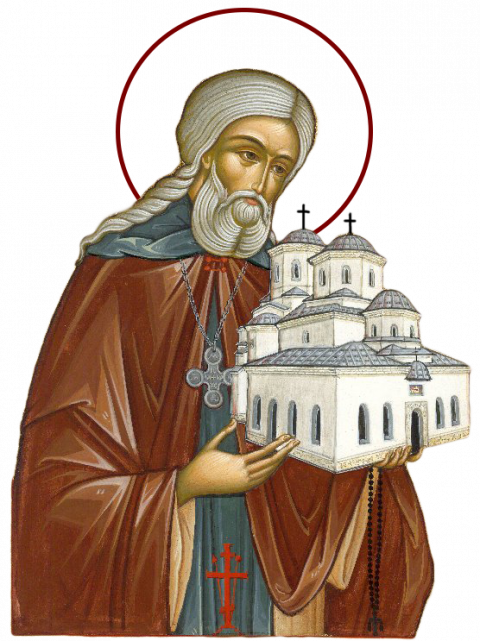
Hieromartyr Euthymius, Bishop of Sardis
The Hieromartyr Euthymius, Bishop of Sardis, during the period of the reign of the Byzantine Emperor Constantine Porphyrogenitos (780-797) and the empress Irene (797-802), was chosen Bishop of Sardis because of his virtuous life. He was also present at the Seventh Ecumenical Council (787), at which he denounced the Iconoclast heresy.
When the Iconoclast emperor Nicephorus I (802-811) came to rule, Saint Euthymius and other Orthodox hierarchs were banished to the island of Patalareia, where they languished for a long time. Recalled from exile by the emperor Leo V (813-820), the bishop boldly denounced the Iconoclast heresy, and they sent him into exile to the city of Assia. The next emperor, Michael II the Stammerer (820-829), attempted to make him renounce icon-veneration, but without success.
Then the holy martyr was flogged and banished to the island of Crete. Michael was succeeded on the throne by the Iconoclast emperor Theophilus (829-842), on whose order Saint Euthymius was subjected to cruel tortures: they stretched him on four poles and beat him with ox thongs. Saint Euthymius fell asleep in the Lord several days after the torture.
Saint Euthymius is also commemorated on March 8.
Troparion — Tone 4
By sharing in the ways of the Apostles, / you became a successor to their throne. / Through the practice of virtue, you found the way to divine contemplation, O inspired one of God; / by teaching the word of truth without error, you defended the Faith, / even to the shedding of your blood. / Hieromartyr Euthymius, entreat Christ God to save our souls.

This year, on this day, is officiated the service usually scheduled on the Sunday after the Lord’s Nativity, celebrating Joseph the Betrothed, Righteous David, the Prophet King, and James, the Brother of the Lord.
The Holy Prophet-King David, Saint Joseph the Betrothed, and Saint James the Brother of the Lord are commemorated on the Sunday after the Nativity. If there is no Sunday between December 25 and January 1, their commemoration is moved to December 26.
At an early date, some churches in the East began to commemorate certain important figures of the New Testament at the time of Theophany, and later during the Nativity season. In Syria, for example, Saint Stephen (December 27), Saints James (April 30) and John (September 26), and Saints Peter and Paul (June 29) were commemorated near the end of December.
In Jerusalem, the saints mentioned above were combined with a feast that the Jews of Hebron celebrated on December 25 or 26 in honor of the Old Testament Patriarch Jacob. Later on, the Christians substituted Saint James (October 23) for Jacob, and then the commemoration of the Brother of the Lord became associated with his ancestor King David. In time, Saint Joseph was linked with Saints David and James.
Saint Joseph had four sons from his previous marriage: James, Judah, Joses, and Simon (or Symeon), and three daughters: Esther, Martha, and Salome, who was the mother of Saint John the Theologian.
Troparion — Tone 2
Proclaim the miracles, O Joseph, / to David, the ancestor of God: / you have seen a Virgin great with child, / you gave glory with the shepherds, / you worshipped with the Magi, / you heard the news from the Angel. / Pray to Christ God to save our souls!
Trd. by oca.org