The Great and Holy Thursday
Two events shape the liturgy of Great and Holy Thursday: the Last Supper of Christ with His disciples, and the betrayal of Judas. The meaning of both is in love. The Last Supper is the ultimate revelation of God’s redeeming love for man, of love as the very essence of salvation.
And the betrayal of Judas reveals that sin, death and self-destruction are also due to love, but to deviated and distorted love, love directed at that which does not deserve love. Here is the mystery of this unique day, and its liturgy, where light and darkness, joy and sorrow are so strangely mixed, challenges us with the choice on which depends the eternal destiny of each one of us.
“Now before the feast of the Passover, when Jesus knew that His hour was come… having loved His own which were in the world, He loved them unto the end…” (John 13:1).
To understand the meaning of the Last Supper we must see it as the very end of the great movement of Divine Love which began with the creation of the world and is now to be consummated in the death and resurrection of Christ.
God is Love (1 John 4:8). And the first gift of Love was life. The meaning, the content of life was communion. To be alive man was to eat and to drink, to partake of the world. The world was thus Divine love made food, made Body of man. And being alive, i.e. partaking of the world, man was to be in communion with God, to have God as the meaning, the content and the end of his life.
Communion with the God-given world was indeed communion with God. Man received his food from God and making it his body and his life, he offered the whole world to God, transformed it into life in God and with God.
The love of God gave life to man, the love of man for God transformed this life into communion with God. This was paradise. Life in it was, indeed, eucharistic.
Through man and his love for God the whole creation was to be sanctified and transformed into one all-embracing sacrament of Divine Presence and man was the priest of this sacrament.
But in sin man lost this eucharistic life. He lost it because he ceased to see the world as a means of Communion with God and his life as eucharist, as adoration and thanksgiving. . . He loves himself and the world for their own sake; he made himself the content and the end of his life.
He thought that his hunger and thirst, i.e. his dependence of his life on the world—can be satisfied by the world as such, by food as such.
But world and food, once they are deprived of their initial sacramental meaning—as means of communion with God, once they are not received for God’s sake and filled with hunger and thirst for God, once, in other words, God is no longer their real “content,” can give no life, satisfy no hunger, for they have no life in themselves…(…)
But if man betrayed, God remained faithful to man. He did not “turn Himself away forever from His creature whom He had made, neither did He forget the works of His hands, but He visited him in diverse manners, through the tender compassion of His mercy” (Liturgy of Saint Basil).
A new Divine work began, that of redemption and salvation. And it was fulfilled in Christ, the Son of God Who in order to restore man to his pristine beauty and to restore life as communion with God, became Man, took upon Himself our nature, with its thirst and hunger, with its desire for and love of, life.
And in Him life was revealed, given, accepted and fulfilled as total and perfect Eucharist, as total and perfect communion with God. He rejected the basic human temptation: to live “by bread alone”; He revealed that God and His kingdom are the real food, the real life of man.
And this perfect eucharistic Life, filled with God, and, therefore Divine and immortal, He gave to all those who would believe in Him, i,e. find in Him the meaning and the content of their lives. Such is the wonderful meaning of the Last Supper.
The Last Supper is the restoration of the paradise of bliss, of life as Eucharist and Communion.
But this hour of ultimate love is also that of the ultimate betrayal. Judas leaves the light of the Upper Room and goes into darkness.
“And it was night” (John 13:30).
Why does he leave? Because he loves, answers the Gospel, and his fateful love is stressed again and again in the hymns of Holy Thursday. It does not matter indeed, that he loves the “silver.” Money stands here for all the deviated and distorted love which leads man into betraying God. It is, indeed, love stolen from God and Judas, therefore, is the Thief.
by Very Rev. Alexander Schmemann, S.T.D.
Professor of Liturgical Theology, Saint Vladimir’s Seminary
Hieromartyr Januarius Bishop of Benevento, and the deacons Proculus, Sossius and Faustus, Desiderius the Reader, Eutychius and Acution suffered martyrdom for Christ about the year 305 during the persecution ordered by the emperor Diocletian (284-305).
They arrested Saint Januarius and led him to trial before Menignus, the governor of Campagna (central Italy). Because of his firm confession of Christianity, they threw the saint into a red-hot furnace. But like the Babylonian youths, he came out unharmed. Then at Menignus’s command, they stretched him out on a bench and beat him with iron rods until his bones were exposed.
In the crowd were Deacon Faustus and the Reader Desiderius, who wept at the sight of their bishop’s suffering. The pagans surmised that they were Christians, and threw them into prison with the hieromartyr Januarius, in the city of Puteolum. At this prison were two deacons who had been jailed for confessing Christ: Saints Sossius and Proculus, and also two laymen, Saints Eutychius and Acution.
On the following morning they led out all the martyrs into the circus to be torn to pieces by wild beasts, but the beasts would not touch them. Menignus claimed that all the miracles were due to sorcery on the part of the Christians, and immediately he became blinded and cried out for help. The gentle hieromartyr Januarius prayed for his healing, and Menignus recovered his sight. The torturer’s blindness of soul, however, was not healed. He accused the Christians of sorcery, and ordered the martyrs beheaded before the walls of the city (+ 305).
Christians from surrounding cities took up the bodies of the holy martyrs for burial, and those of each city took one, in order to have an intercessor before God. The inhabitants of Neapolis (Naples) took the body of the hieromartyr Januarius. With the body, they also collected his dried blood.
Since the fifteenth century, the blood liquifies when the container is placed near another relic, believed to be the martyr’s head. Many miracles proceeded from the relics of the hieromartyr Januarius. During an eruption of Vesuvius around 431, the inhabitants of the city prayed to Saint Januarius to help them. The lava stopped, and did not reach the city.
Troparion — Tone 3
Naples has found you a champion in dangers, / O Januarius, our glorious father. / You delivered her from plague, famine and affliction, / and from the fire of Vesuvius. / With faith and love we venerate you and honor your holy relics!
Hieromartyr Theodore of Perge in Pamphylia
The Holy Martyrs Theodore, his mother Philippa, Dioscorus, Socrates and Dionysius suffered during the reign of the emperor Antoninus Pius (138-161) in Perge, Pamphylia. When they were conscripting robust and healthy young men for military service, then they led the youth Theodore and the others to the military commander Theodotus.
The military commander ordered the youth to offer sacrifice to idols, but the martyr submitted neither to persuasion nor threats. Then the military commander had him placed on a red-hot plate and poured liquid tar on him. Suddenly, there was an earthquake, and a torrent of water gushed forth from the ground and extinguished the fire.
The martyr Theodore remained unharmed, and gave praise to God. The commander ascribed his deliverance to sorcery, so Saint Theodore suggested that he test the power of his gods by putting the pagan priest Dioscorus through the same trials.
The commander told Dioscorus to lie upon the red-hot plate, and call on the help of Zeus. Saint Dioscorus replied that he believed in Christ, and he was prepared to throw the idol of Zeus into the fire. Again the military commander commanded him to get on the heated plate. Saint Dioscorus fell at the knees of Saint Theodore, asking that he pray for him. Then he got onto the plate, crying out: “I thank You, Lord Jesus Christ, that You have numbered me among Your servants. Accept my soul in peace.” Then he died, having been delivered from terrible torment.
They continued to torture Saint Theodore. They tied him to wild horses, which began to run. But at the city walls the horses fell down and collapsed, and the martyr Theodore remained unharmed. Two soldiers, Socrates and Dionysius, saw how a fiery chariot came down from the heavens to Saint Theodore, on which the martyr was carried off.
In the morning, the military commander ordered soldiers to look upon the burned bodies of the martyrs. The soldiers returned and reported that the three youths were unharmed. Saint Theodore’s mother, Philippa, encouraged the martyrs in their act.
The military commander told Saint Philippa to save her son, by urging him to offer sacrifice to the idols. Saint Philippa said that when her son was born it was revealed to her that he would be crucified for Christ. Hearing this, the military commander commanded them to crucify Saint Theodore, and to cut off the heads of the other martyrs. Saint Theodore hung on the cross for three days, offering prayers to God until he finally died.
Troparion — Tone 4
Your holy martyrs O Lord, / through their sufferings have received incorruptible crowns from You, our God. / For having Your strength, they laid low their adversaries, / and shattered the powerless boldness of demons. / Through their intercessions, save our souls!
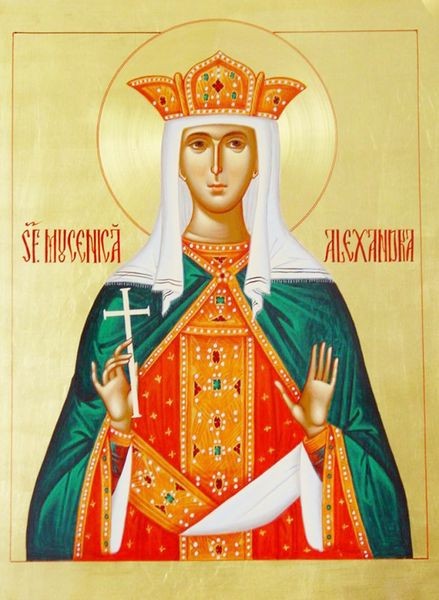
Martyr Alexandra the Empress, wife of Diocletian
The Holy Empress Alexandra was the wife of Diocletian (284-305). Her supposed death was described in the Martyrdom of Saint George, which was written immediately after his death. The empress, however, received the crown of martyrdom several years later, in 314.
Many events occurred during these years. In 305 the emperor Diocletian resigned the throne and power passed to his co-ruler Maximian Galerius (305-311), a fanatic pagan, as well as a coarse and fierce soldier. His wife was Saint Valeria, the daughter of the holy Empress Alexandra, whom Diocletian had given in marriage against her will.
Saint Alexandra raised her daughter in Christian piety. When Galerius died, the emperor Maximinus sought her hand in marriage. When he was refused, he banished Saint Valeria to Syria, where she lived with her mother.
After the death of Maximinus in 311 the mother and daughter arrived in Nicomedia, trusting in the mercy of the emperor Licinius (311-324). Together with Saint Constantine, he had subscribed to the Edict of Milan, which gave Christians the freedom of religion, but secretly he remained an enemy of Christianity. Licinius gave orders to execute the holy Empress Alexandra and her daughter Valeria. They were beheaded, and their bodies thrown into the sea.
Tr by oca.org