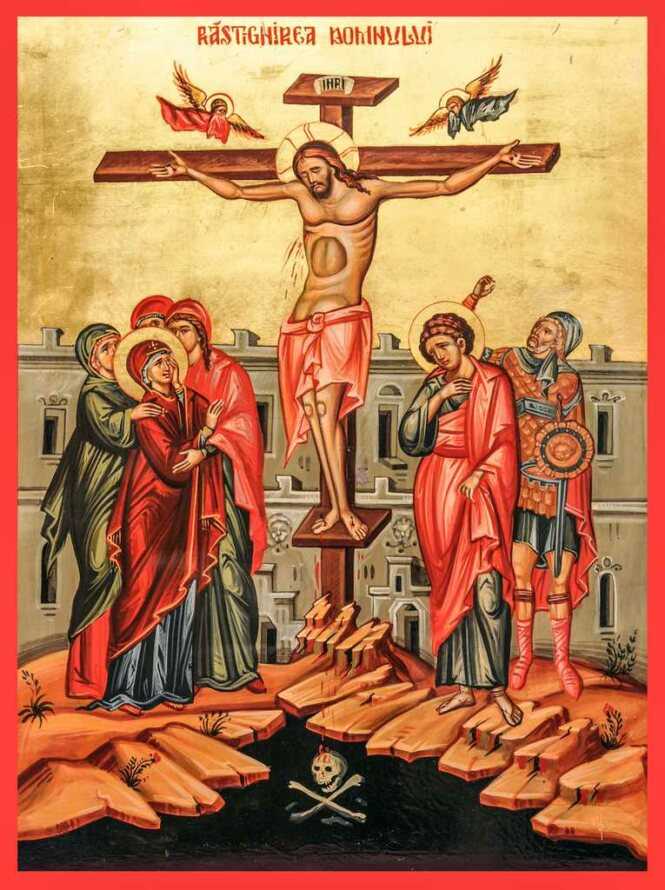
Great and Holy Friday
On Great and Holy Friday, Christ died on the Cross. He gave up His spirit with the words: “It is finished” (John 19:30). These words are better understood when rendered: “It is consummated.” He had accomplished the work for which His heavenly Father had sent Him into the world. He became a man in the fullest sense of the word. He accepted the baptism of repentance from John in the Jordan River. He assumed the whole human condition, experiencing all its alienation, agony, and suffering, concluding with the lowly death on the Cross. He perfectly fulfilled the prophecy of Isaiah:
“Therefore I will divide him a portion with the great, and he shall divide the spoil with the strong; because he has poured out his soul to death, and was numbered with the transgressors; yet he bore the sins of many, and made intercession for the transgressors.”
(Isaiah 53:12)
The Man of Sorrows
On the Cross Jesus thus became “the man of sorrows; acquainted with grief” whom the prophet Isaiah had foretold. He was “despised and forsaken by men” and “smitten by God, and afflicted” (Isaiah 53:3-4). He became the one with “no form or comeliness that we should look at him, and no beauty that we should desire him” (Isaiah 53:2). His appearance was “marred beyond human semblance, and his form beyond that of the sons of men” (Isaiah 52:14). All these Messianic prophecies were fulfilled in Jesus as he hung from the Cross.
As the end approached, He cried: “My God, my God, why hast Thou forsaken me?” (Matthew 27:46). This cry indicated His complete identification with the human condition. He had totally embraced the despised, forsaken and smitten condition of suffering and death—alienation from God. He was truly the man of sorrows.
Yet, it is important to note that Jesus’ cry of anguish from the Cross was not a sign of His loss of faith in His Father. The words which He exclaimed are the first verse of Psalm 22, a messianic Psalm. The first part of the Psalm foretells the anguish, suffering and death of the Messiah. The second part is a song of praise to God. It predicts the final victory of the Messiah.
The Formal Charges
The death of Christ had been sought by the religious leaders in Jerusalem from the earliest days of His public ministry. The formal charges made against Him usually fell into the following two categories:
1) violation of the Law of the Old Testament, e.g., breaking the Sabbath rest;
2) blasphemy: making Himself equal with God.
Matters were hastened (consummated) by the moment of truth which followed His entrance into Jerusalem on Palm Sunday. He had the people behind Him. He spoke plainly. He said that the Sabbath was made for man, and not man for the Sabbath. He chastised the scribes and Pharisees for reducing religion to a purely external affair;
“You are like whitewashed tombs, which outwardly appear beautiful, but within are full of dead men’s bones and all uncleanness. So you also outwardly appear righteous to men, but within you are full of hypocrisy and iniquity” (Matthew 23:27-28).
It was the second formal charge; however, that became the basis for His conviction.
The Religious Trial
Christ’s conviction and death sentence required two trials: religious and political. The religious trial was first and took place during the night immediately after His arrest. After considerable difficulty in finding witnesses for the prosecution who actually agreed in their testimony, Caiaphas, the high priest, asked Jesus the essential question: “Are you Christ, the Son of the Blessed?” Jesus, who had remained silent to this point, now responded directly:
“I am; and you will see the Son of man sitting at the right hand of power, and coming with the clouds of heaven” (Mark 14:61-62).
Jesus’ reply recalled the many other statements He had made beginning with the words, “I am.” “I am the bread of life . . . I am the light of the world. . . I am the way, the truth, and the life. . . before Abraham was, I am.” (John 6 through 15). The use of these words themselves was considered blasphemous by the religious leaders. The words were the Name of God. By using them as His own Name, Jesus positively identified Himself with God. From the burning bush the voice of God had disclosed these words to Moses as the Divine Name:
“Say this to the people of Israel, ‘I AM has sent me to you’” (Exodus 3:13-14).
Now Jesus, as He had done on many other occasions, used them as His own Name. The high priest immediately tore his mantle and “they all condemned Him as deserving death” (Mark 14:64). In their view He had violated the Law of the Old Testament:
“He who blasphemes the name of the Lord shall be put to death” (Leviticus 24:16).
The Political Trial
The Jewish religious leaders lacked the actual authority to carry out the above law: to put a man to death. Such authority belonged to the Roman civil administration. Jesus had carefully kept His activity free of political implications. He refused the temptation of Satan to rule the kingdoms of the world by the sword (Luke 4: 1-12). He often charged His disciples and others to tell no one that He was , the Christ, because of the political overtones that this title carried for many (Matthew 16: 13-20). He rebuked Peter, calling him Satan, when the disciple hinted at His swerving from the true nature of His mission (Matthew 16:23). To Pilate, the spineless and indifferent Roman Governor, He said plainly: “My kingdom is not of this world” (John 18:36). Jesus was not a political revolutionary who came to free the people from Roman control and establish a new kingdom based on worldly power.
Nevertheless, the religious leaders, acting in agreement with the masses, devised political charges against Him in order to get their way. They presented Christ to the Romans as a political , leader, the “King of the Jews” in a worldly sense, a threat to Roman rule and a challenge to Caesar. Pilate became fearful of his own position as he heard the charges and saw the seething mobs. Therefore, despite his avowed testimony to Jesus’ innocence, he passed formal sentence, “washed his hands” of the matter, and turned Jesus over to be crucified (John 19:16).
Crucifixion—The Triumph of Evil
Before succumbing to this cruel Roman method of executing political criminals, Jesus suffered still other injustices. He was stripped, mocked and beaten. He wore a “kingly” crown of thorns on His head. He carried His own cross. He was finally nailed to the cross between two thieves at a place called Golgotha (the place of the skull) outside Jerusalem. An inscription was placed above His head on the Cross to indicate the nature of His crime: “Jesus of Nazareth, the King of the Jews.” He yielded up His spirit at about the ninth hour (3 p.m.), after hanging on the Cross for about six hours.
On Holy Friday evil triumphed. “It was night” (John 13:30) when Judas departed from the Last Supper to complete his act of betrayal, and “there was darkness over all the land” (Matthew 27:45) when Jesus was hanging on the Cross. The evil forces of this world had been massed against Christ. Unjust trials convicted Him. A criminal was released to the people instead of Him. Nails and a spear pierced His body. Bitter vinegar was given to Him to quench His thirst. Only one disciple remained faithful to Him. Finally, the tomb of another man became His place of repose after death.
The innocent Jesus was put to death on the basis of both religious and political charges. Both Jews and Gentile Romans participated in His death sentence.
“The rulers of the people have assembled against the Lord and His Christ.” (Psalm 2—the Prokeimenon of the Holy Thursday Vesperal Liturgy)
We, also, in many ways continue to participate in the death sentence given to Christ. The formal charges outlined above do not exhaust the reasons for the crucifixion. Behind the formal charges lay a host of injustices brought, on by hidden and personal motivations. Jesus openly spoke the truth about God and man. He thereby exposed the false character of the righteousness and smug security, both religious and material, claimed by many especially those in high places. The constantly occurring expositions of such smugness in our own day teach us the truly illusory nature of much so-called righteousness and security. In the deepest sense, the death of Christ was brought about by hardened, personal sin—the refusal of people to change themselves in the light of reality, which is Christ.
“He came to His very own, and His own received Him not” (John 1:11).
Especially we, the Christian people, are Christ’s very own. He continues to come to us in His Church. Each time we attempt to make the Church into something other than the eternal coming of Christ into our midst, each time we refuse to repent for our wrongs; we, too, reject Christ and participate in His death sentence.
Saint Theodore the Sykeote
Saint Theodore the Sykeote was born in the mid-sixth century in the village of Sykeon, not far from the city of Anastasiopolis (in Galatia, Asia Minor), into a pious family. When his mother Maria conceived the saint, she had a vision of a bright star overshadowing her womb. A clairvoyant Elder, whom she consulted, explained that this was the grace of God being poured forth on the infant in her womb.
When the boy reached the age of six, his mother presented him with a golden belt, since she intended that her son should become a soldier. That night the Holy Great Martyr George (April 23) appeared to her in a dream, and he told her not to consider military service for her son, because the boy was destined to serve God. The saint’s father, Cosmas, had served as a messenger of the emperor Justinian the Great (527-565), and he died at an early age. The boy remained in the care of his mother, and his grandmother Elpis, his aunt Dispenia and his little sister Vlatta also lived with them.
In school, Saint Theodore displayed great apptitude in his studies, chief of which was an uncommon ability for reasoning and wisdom. He was quiet, mild, he always knew how to calm his comrades, and he did not permit fights or quarrels among them.
The pious Elder Stephen also lived at his mother’s house. Imitating him, Saint Theodore at the age of eight began to eat only a small morsel of bread in the evening during Great Lent. So that his mother should not force him to take supper with everyone, the boy returned home from school only toward evening, after he had partaken of the Holy Mysteries with Elder Stephen. At the request of his mother, the teacher began to send him home to supper at the end of his lessons. Saint Theodore, however, ran to the church of the Great Martyr George, where the saint appeared to him in the form of a youth, and ushered him into the church.
When Saint Theodore turned ten, he fell deathly ill. They brought him to the church of Saint John the Baptist and placed him in front of the altar. The boy was healed by two drops of water that fell from the face of the Savior in the dome of the temple. At this time the Great Martyr George began appearing to the boy at night, and also leading him to his own temple to pray until morning. His mother, fearing the dangers of the forest at night, urged her son not to go at night.
Once, when the boy had already gone, she angrily followed him to the church, and she dragged him out by the hair and tied him to his bed. But that very night the Great Martyr George appeared to her in a dream, and commanded her not to hinder the child from going to church. Both Elpis and Dispenia had the same vision. The women then understood Saint Theodore’s special calling, and they no longer hindered him. Even his little sister Vlatta began to imitate him.
At twelve years of age, the saint had a dream in which he saw Christ on the Throne of Glory, Who said to him, “Struggle, Theodore, so that you may obtain a perfect reward in the Kingdom of Heaven.”
From that time, Saint Theodore began to intensify his labors. He spent both the First Week of Great Lent and the Week of the Veneration of the Cross in complete silence.
The devil considered how to destroy him. He appeared to the saint in the form of his classmate Gerontius, and urged him to jump off a precipice, but the Great Martyr George saved the boy.
Another time, the boy went into the desert to obtain the blessing of the Elder Glycerius. Then there was a terrible drought throughout the land, and the Elder said, “Child, let us pray to the Lord on bended knee, asking Him to send rain. Then we shall learn whether our prayers are pleasing to the Lord.” The old man and the boy began to pray, and immediately it began to rain. Then the Elder said to Saint Theodore, that the grace of God was upon him, and he blessed him to become a monk when the time came.
When he was fourteen, Saint Theodore left home and lived near the church of the Great Martyr George. His mother brought him food, but Saint Theodore left everything on the stones by the church, and he ate only a single prosphora each day. Even at such a young age, Saint Theodore was granted the gift of healing. Through his prayers a demon-possessed youth was restored to health.
Saint Theodore then fled human glory and he withdrew into complete solitude. Under a large boulder not far from the church of Saint George, he dug a cave and persuaded a certain deacon to cover over the entrance with earth, leaving only a small opening for air. The deacon brought him bread and water and he told no one,where the monk had hidden himself.
For two years Saint Theodore lived in this seclusion and complete quiet. His relatives mourned for the saint, thinking that he had been devoured by wild beasts.
The deacon finally revealed the secret, since he was afraid that Saint Theodore would perish in the narrow cave, and moreover he pitied the weeping mother. They took Saint Theodore out of the cave barely alive.
The mother wanted to take her son home and nurse him back to health, but the saint remained near the church of Saint George, and after several days he was completely well.
News of the youth’s exploits reached the local bishop Theodosius, who ordained him to the diaconate, and later to the holy priesthood, although the saint was only seventeen years old at the time.
After a certain while Saint Theodore went to venerate the holy places in Jerusalem, and there at the Chozeba Lavra near Jordan, he received monastic tonsure.
When he returned to his native land, he again continued to live near the church of Saint George. His grandmother Elpis, his sister Vlatta and his mother entered a women’s monastery on the saint’s advice, and his aunt died in a good confession.
The ascetic life of the young hieromonk attracted to him people seeking salvation. The saint tonsured the youth Epiphanius, and later on a pious woman, healed by the saint from her sickness, brought him her son Philoumenus. Then the virtuous youth John also came to him. Thus brethren gradually gathered around the monk.
Saint Theodore continued in his harsh labors. At his request a blacksmith made him an iron cage without a roof, and so narrow that it was scarcely possible to stand. In this cage the monk stood in heavy chains from Holy Pascha until the Nativity of Christ. From the Baptism of the Lord until Holy Pascha he secluded himself in his cave, from which he emerged only for church services on Saturdays and Sundays. Throughout the whole of the forty-day Fast the saint ate only greens, and bread on Saturdays and Sundays.
Living in such manner, he received from the Lord the power over wild animals. Bears and wolves came up to him and took food from his hand. Through the saint’s prayers, those afflicted with leprosy were healed, and demons were cast out from whole districts. In the nearby village of Magatia, when locusts threatened the crops, people turned to Saint Theodore for help. He sent them to church. After Divine Liturgy, which he served, the villagers returned home and learned that during the service all the locusts had died.
When the military commander Mauricius was returning to Constantinople by way of Galatia after a Persian war, the monk predicted that he would become emperor. The prediction came true, and the emperor Mauricius (582-602) fulfilled the saint’s request: he sent bread to the monastery each year for the multitude of people being fed there.
The small temple of Saint George could not accommodate all those who wanted to pray in it. Then through the efforts of the saint a beautiful new church was built. During this while the Bishop of Anastasiopolis happened to die. The people of the city requested Metropolitan Paul of Ancyra to install Saint Theodore as their bishop.
So that the saint would not resist, the messengers of the Metropolitan and the people of Anastasiopolis dragged him out of his cell by force and carried him into the city.
As bishop, Saint Theodore toiled much for the welfare of the Church, but his soul yearned for solitary communion with God. After several years he went to venerate the holy places in Jerusalem. And there, concealing his identity, he settled at the Lavra of Saint Sava, where he lived in solitude from the Nativity of Christ until Pascha. Then the Great Martyr George led him to return to Anastasiopolis.
Secret enemies tried to poison the saint, but the Mother of God gave him three small pieces of grain. The saint ate them and remained unharmed. Saint Theodore felt weighed down with the burden of being a bishop and he asked Patriarch Cyriacus of Constantinople (595-606) for a release to return to his own monastery and celebrate the services there.
Theodore’s sanctity was so evident that when he celebrated the Eucharist, the grace of the Holy Spirit appeared as a radiant purple light, overshadowed the Holy Gifts. One time, when the saint elevated the discus with the holy Lamb and proclaimed “Holy things are for the holy,” the holy Lamb floated up in the air, and then settled again upon the discus.
The Orthodox Church venerated Saint Theodore as a saint, even while he was still alive.
In one of the cities of Galatia, a terrible event occurred: during a church procession the wooden crosses being carried began to strike each other by themselves, with the result that Patriarch Thomas (607-610, March 21) summoned Saint Theodore, asking him the meaning of this terrible portent. Having the gift of foresight, Saint Theodore explained that this indicated coming misfortunes for the Church of God (he was prophetically indicating the future heresy of the Iconoclasts). In his grief the holy Patriarch Thomas begged the saint to pray that he would soon die, so that he would not witness the coming woe.
In the year 610 the holy Patriarch Thomas reposed, having asked the blessing of Saint Theodore. Saint Theodore also departed to the Lord.
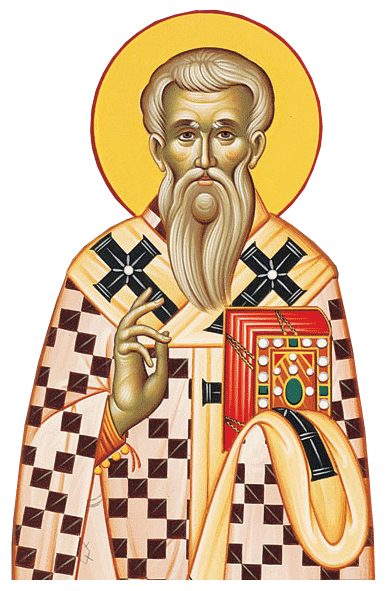
Troparion, tone 2:
You were known to be sanctified from your earliest infancy. You were revealed to be filled with grace. You enlightened the world with miracles and drove away a multitude of demons, holy hierarch Theodore. Therefore, pray to the Lord for us.