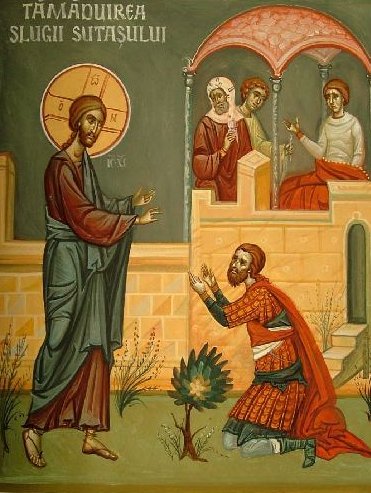
Fourth Sunday after Pentecost. The Healing of the Centurion’s Servant
Now when Jesus had entered Capernaum, a centurion came to Him, pleading with Him, saying, “Lord, my servant is lying at home paralyzed, dreadfully tormented.” And Jesus said to him, “I will come and heal him.” The centurion answered and said, “Lord, I am not worthy that You should come under my roof. But only speak a word, and my servant will be healed. For I also am a man under authority, having soldiers under me. And I say to this one, ‘Go,’ and he goes; and to another, ‘Come,’ and he comes; and to my servant, ‘Do this,’ and he does it.”When Jesus heard it, He marveled, and said to those who followed, “Assuredly, I say to you, I have not found such great faith, not even in Israel! And I say to you that many will come from east and west, and sit down with Abraham, Isaac, and Jacob in the kingdom of heaven. But the sons of the kingdom will be cast out into outer darkness. There will be weeping and gnashing of teeth.” Then Jesus said to the centurion, “Go your way; and as you have believed, so let it be done for you.” And his servant was healed that same hour.
(Matthew 8:5-13)
The Forty-five Martyrs of the Armenian City of Nicopolis
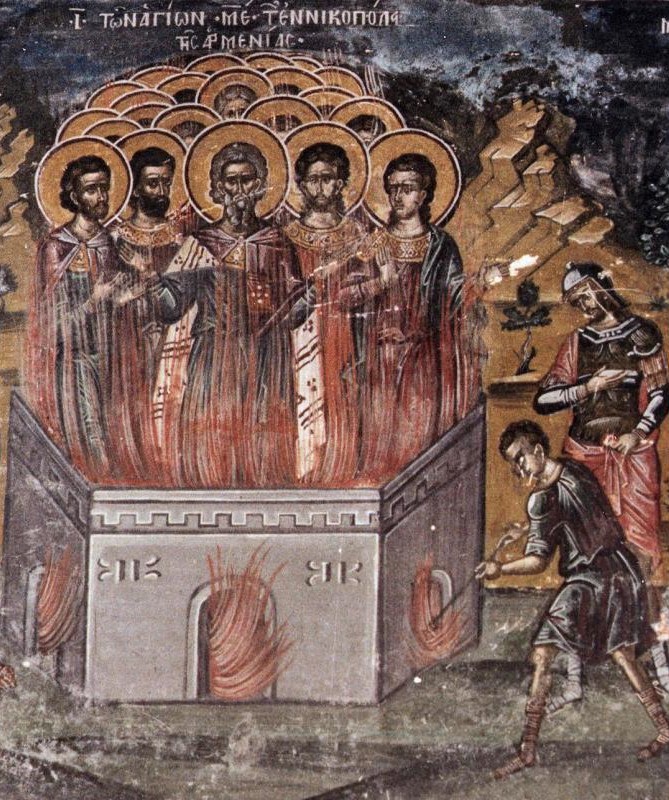
They suffered during the reign of the emperor Licinius (311-324), then a co-regent with Constantine the Great.
Licinius, the ruler of the Eastern Empire, fiercely persecuted Christians and issued an edict to put to death any Christian who would not return to paganism. When the persecutions began at Nicopolis, more than forty of the persecuted of Christ decided to appear voluntarily before their persecutors, to confess openly their faith in the Son of God and accept martyrdom. The holy confessors were headed by Leontius, Mauricius, Daniel, Anthony and Alexander, and were distinguished by their virtuous life.
The procurator of the Armenian district, Licius, before whom the holy confessors presented themselves, was amazed at the directness and bravery of those who voluntarily doomed themselves to torture and death. He tried to persuade them to renounce Christ and offer sacrifice to the pagan gods, but the saints remained steadfast. They refuted all the arguments of the governor, pointing out to him all the falseness of faith in the vile and vice-filled pagan gods, leading those that worship them to ruin. The procurator gave orders to beat the confessors about the face with stones, and then shackle and imprison them.
In prison the saints rejoiced and sang the Psalms of David. Saint Leontius inspired and encouraged the brethren, preparing them to accept new tortures for the true Faith, and telling them of the bravery of all those formerly that had suffered for Christ. In the morning, after repeated refusals to offer sacrifice to the idols, the saints were again given over to torture. Saint Leontius, seeing the intense suffering of the martyrs and worrying that some of them might falter and lose faith, prayed to God that there might be a quick end of the matter for all.
When the holy martyrs sang Psalms at midnight, an angel of the Lord suddenly appeared to them, and the prison blazed with light. The angel declared to the martyrs that their contest was near its end, and their names already were inscribed in Heaven. Two of the prison guards, Meneus and Virilad, saw what was happening and believed in Christ. On the following morning, the governor decided to put the martyrs of Christ to death.
After beastly tortures they burned them in a fire, and threw their bones in a river. Pious people found the relics, gathered them up and saved them. Later on, when freedom had been bestowed to the Church of Christ, a church was built on this spot in the name of the holy 45 Martyrs.
Your holy martyrs, O Lord, through their suffering have received incorruptible crowns from You, our God. For having Your strength, they laid low their adversaries, and shattered the powerless boldness of demons. Through their intercessions save our souls!