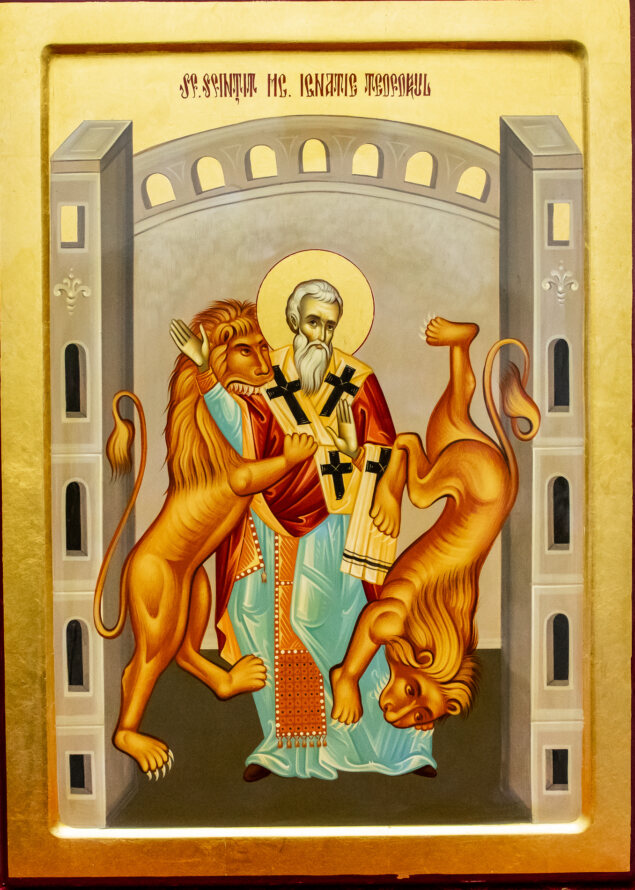
1. The Transfer of the Relics of the Hieromartyr Ignatius the God-Bearer: (See December 20). After the holy hieromartyr Ignatius was thrown to the lions in the year 107 on the orders of the emperor Trajan, Christians gathered up his bones and preserved them at Rome.
Later, in the year 108, the saint’s relics were collected and buried outside the gate of Daphne at Antioch. A second transfer, to the city of Antioch itself, took place in the year 438. After the capture of Antioch by the Persians, the relics of the Hieromartyr Ignatius were returned to Rome and placed into the church of the holy Hieromartyr Clement in the year 540 (in 637, according to other sources).
Saint Ignatius introduced antiphonal singing into Church services. He has left us seven archpastoral epistles in which he provided instructions on faith, love and good works. He also urged his flock to preserve the unity of the faith and to beware of heretics. He encouraged people to honor and obey their bishops, “We should regard the bishop as we would the Lord Himself.” (To the Ephesians 6)
In his Letter to Polycarp, Saint Ignatius writes: “Listen to the bishop, if you want God to listen to you… let your baptism be your shield, your faith a helmet, your charity a spear, your patience, like full armor.” (Compare Eph. 6:14-17 and the Wisdom of Solomon 5:17-20.
Troparion — Tone 4
By sharing in the ways of the Apostles, / you became a successor to their throne. / Through the practice of virtue, you found the way to divine contemplation, O inspired one of God; / by teaching the word of truth without error, you defended the Faith, / even to the shedding of your blood. / Hieromartyr Ignatius, entreat Christ God to save our souls.
2. The Holy Martyrs Philotheus, Romanus, James, Hyperichius, Habib, Julian, and Parigoreas suffered in the year 297, during the persecution by Diocletian (284-305), in the city of Samosata (in Syria on the River Euphrates). They bravely denounced the senseless worship of idols, for which they were arrested and given over to various terrible tortures. Their bodies were scraped with iron, heavy iron fetters were hung around their necks, and they were locked up in prison. Finally, nails were driven into their heads while they were suspended on crosses.
Sunday of the Canaanite Woman
Mathew, the Evangelist, tells us that the Lord went out to the areas of Tyre and Sidon, to the regions inhabited by the pagan nations (who were known as Gentiles). In the Apostle Mark’s account, there was a woman there who was ” a Syrophoenician by nation,” (Mark 7:26).
This woman appeared out of the pagan crowds and headed towards Jesus shouting a prayer common among Jewish believers, “Have mercy on me Oh Lord, son of David.” This is a prayer we have seen over and over commonly uttered by those of a believing Jewish background, often when they’ve appealed to Christ to heal them, like the blind man for example.
But for the first time, we see these words come from the lips of a Canaanite pagan woman, who is not a descendant of Abraham and not of the chosen people expecting the coming of the Messiah. It is plausible to accept that perhaps this Canaanite woman was the first of a pagan background to show evidence of faith in the Lord Jesus Christ as Saviour.
Through this woman’s faith and humility, the way for the pagan nations to enter into the true faith and light was illumined and opened. The Lord Jesus gave His mission to His disciples after His resurrection to “go and disciple all nations and baptise them in the name of the Father, the Son, and the Holy Spirit” (Matthew 28:19).
When Mathew wrote his Gospel to the Jews, he intended to focus on this particular incident to remind them that “God will claim all the ends of the earth to repent to him and to be saved, and worship Him alone” Isaiah (45:22-23) and that “God would bring strangers to His sacred mountain to join in worshiping Him there” (Isaiah 56:7).
Subsequent incidents such as the belief of the Centurion and the Samaritan women prove that the work of God’s salvation begins with the Jewish community as a starting point, but it is open to everyone without exception, since in the Lord Jesus Christ “there is no Jewish or Greek. Neither a slave nor a free. Not male and female, because you are all one in Jesus Christ. If you are for Christ, then you are the descendants of Abraham and according to the promise, the heirs”. (Galatians 3:28-29).
(+ Metropolitan Basilios of the Antiochian Orthodox Archdiocese of Australia, New Zealand and the Philippines, Feb. 8, 2019, online at Antiochian.org.au)
Trd. by oca.org