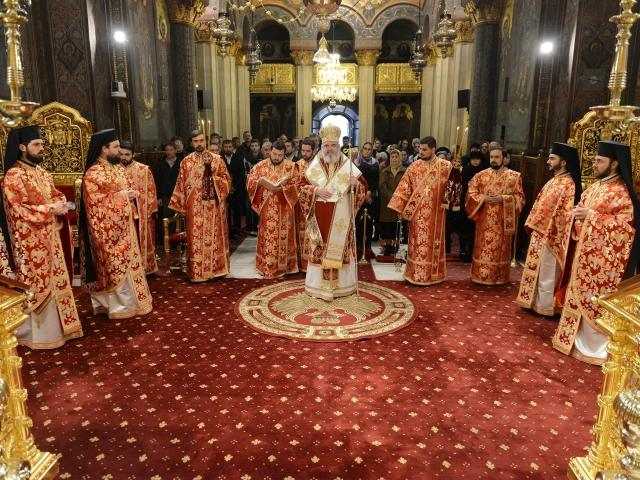
Today, 17 April 2014, Maundy Thursday, His Beatitude Daniel, Patriarch of the Romanian Orthodox Church celebrated the Divine Liturgy united with the Vesper at the Patriarchal Cathedral, assisted by a group of priests and deacons.
His Beatitude Patriarch Daniel delivered a sermon in which he said: “On this holy day we remember four special things of Jesus Christ, our Lord, namely: washing of the feet of his disciples, as a sign of lowliness as example given to all of us to be humble, not trying to be the first; teaching the holy frightening mysteries, namely the celebration of the Last Supper which is the basis of the Holy Eucharist and commandment of Jesus Christ, our Saviour, when He said: Do this in remembrance of Me; the prayer of Jesus Christ in Gethsemane when He prayed the Heavenly Father as Man if possible to pass this cup from Him, namely the sufferance of the Cross and death; betrayal of Christ by His disciple Jude the Iscariot who was greedy of money and envious. We remember this treason because we see how changing the human nature is unless he or she prays the Holy Spirit. The human is dominated by the evil spirits in the course of time which are hidden in the selfish passions”.
What we do celebrate today is the Holy Last Supper which is the basis of the Christian Easter, the Patriarch of Romania said, showing that “this Last Supper was instituted by Jesus Christ, our Lord, as soon as He celebrated the Passover. As the Holy Fathers say, the interpreters of the Holy Gospels, Jesus, our Lord, and His disciples celebrated first the Passover, not to be accused they have infringed Moses’ law. There followed a Supper of Jesus Christ, our Lord, as in a family, with the blessing of the bread and wine. After Jesus Christ, our Saviour, celebrated the Passover, He instituted the new Easter. This new Easter has nothing of the old Easter which was a prefiguration of Christ. The Pascal lamb of the Passover was He, the Lamb that raised the sins of the world. The passage through the Red Sea becomes the passage through the bloody sacrifice of Christ. The entry into the Promised Land becomes the entry into the Kingdom of Heaven.
“The identification of the bread with the Body of Christ and of the wine with the blood of Christ, as well as the identification of the Pascal lamb with Christ represents the great mystery. This is why it is named the Mysterious Supper or the Mystic Supper. When we have the Body and Blood of Christ we do not unite with something material, but with Somebody who is the divine-human Person of Christ”, His Beatitude Daniel also said.
The Patriarch of Romania showed that the true life is the Eucharistic one, of gratitude towards God: “In the Holy Eucharist we celebrate both the Sacrifice of the Saviour on the Cross, and the power of His Resurrection. This is why when the prayers after the Holy Eucharist are read the Easter is referred to. Easter means our passage from sins to holiness, from death to life, from the earthly life to the heavenly life. Everything is included in the Mystery of the Holy Eucharist: the unlimited love of God for us, the Mystery of the Sacrifice and the Mystery of the Resurrection. In conclusion, this day shows us that the only true life is the Eucharistic life, of gratitude to God for the gift of life, and for everything we receive and we hope from Him. The gift of the earthly life is crowned with the gift of the heavenly life, with the eternal life.”
Besides the Agnet of the Liturgy, a second agnet was blessed at this Divine Liturgy, which would be dried and crushed at the Liturgy on the third day of the Easter of Saint John Chrysostom, in a special rite. The miride (crumbs) resulted are used as Holy Communion for the sick, children and in special cases. This Holy Communion is kept in the Holy Shrine in the Holy Altar, on the Holy Table.
The Holy Agnet is a square shaped part of the bread on which the four words are printed: IS, HR, NI, KA, namely Jesus Christ Victorious. Translated, agnet means “lamb” representing Christ, the Saviour, the Lamb who sacrifices himself for the people’s sins and for forgiving them.