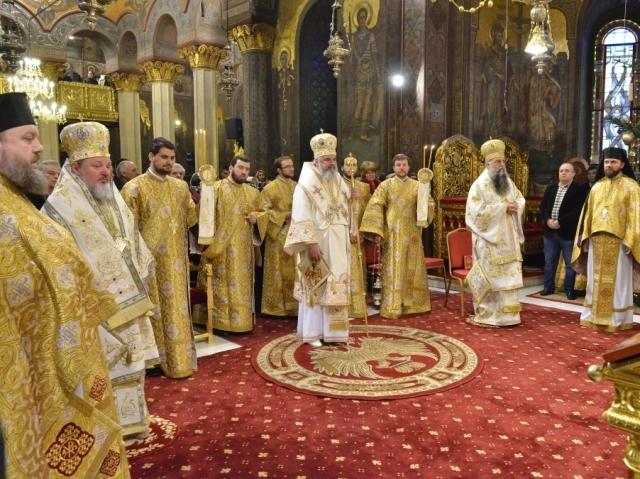
On 1 January 2014, the Orthodox Church celebrates the Circumcision of Jesus Christ, our Lord, and Saint Basil the Great, Archbishop of Caesarea of Cappadocchia. On the first day of the civil New Year 2014, His Beatitude Daniel, Patriarch of the Romanian Orthodox Church celebrated the Divine Liturgy at the Patriarchal Cathedral, together with His Grace Varlaam Ploiesteanul, Assistant Bishop to the Patriarch and His Grace Varsanufie Prahoveanul, Assistant Bishop to the Archdiocese of Bucharest, assisted by a group of priests and deacons, in the presence of many faithful.
After reading the Evangelical pericope of Saint Evangelist Luke (chapter 2:20-21; 40-52), His Beatitude delivered a sermon in which he emphasised its significance and spoke about the feasts of the day.
The Circumcision Prefigured the Christian Baptism
The Patriarch of Romania showed that “On 1 January we celebrated three holy feasts, three great blessings of God for the humans. The first one is the Circumcision of the Jesus Christ, our Lord and Saviour, and the second one is the celebration of Saint Basil the Great, Archbishop of Caesarea of Cappadocchia. On 1 January we also celebrate the civil New Year. We do know that the new religious year is celebrated on 1 September. The first feast has lots of spiritual meanings for the life of the Church and for our life as well. The circumcision of Infant Jesus when eight days old was a Jewish tradition by which the exodus of the chosen people and keeping of the right faith in the Living God was celebrated, the God of Abraham, Isaac and Jacob and Creator of the heaven and earth. This circumcision prefigured the Baptism because Saint Paul the Apostle spoke about the circumcision according to the Spirit, namely circumcision as removal of the bad thoughts, words and deeds from the human’s soul. Thus, this circumcision has not been taken over by the Church, because it was a tradition of the Old Testament before Christ, but He could not give a new law till He has not accomplished the old law, so that He was circumcised when eight days old. Thus, we believe that after accomplishing the old Law, the new Law is inaugurated, which is the Baptism in the water and in the Holy Spirit. So, the circumcision prefigured the Christian Baptism.”
The Gospel urges us to use the time of the present life first to develop our wisdom
The Primate of the Romanian Orthodox Church explained in his sermon that child Jesus’ wisdom was greater than his biological age: “Today’s Gospel tells us that after His parents found Him in the Temple they took Him home, to Nazareth. Here, He was obedient and grew up in age, wisdom and grace for God and humans. This means that He had greater wisdom, bigger than his biological age, but his growth in age and wisdom were due to the grace of God. The Gospel urges us to use the time of the present life first of all to grow in wisdom which must be greater than the physical or biological growth, so that we feel the blessing of the grace of God in all this process”.
The philanthropic work (of Saint Basil the Great) stemmed from the Gospel and named later on “Vasiliada” was the model of the institutionalised philanthropic or charitable work
“The second feast is the celebration of Saint Basil the Great. The Saint is one of the few saints of the name “the Great” due to the importance of his work in favour of the Church, as well as to his great wisdom and devotion stemmed from the right deep faith. Saint Basil the Great was born in 330 and passed away on 1 January 379. First of all, in his time two heresies were widely spread: the heresy of Arie who denied the divinity of the Son and the heresy of Macedonie who denied the divinity of the Holy Spirit. He contested the heretics and showed that God is the Father, God is the Son and God is the Holy Spirit and that the three Persons are the same Being. They are equal and unseparated. Although there are three persons in the Holy Trinity, it is only one God because the source of Divinity is the Father. The Son is eternally born from the Father, and the Holy Spirit eternally proceeds from the Father. Thus, the unity of divinity is not broken because there is only one Source of Divinity and a single Being, and the relationships among the three persons are relationships of mutual devotion and containing named perihoresis. Thus, the Trinity is one and unseparated, but because there are three Persons who always love one another the God of the Christians is the God love. If God had been a single Person it would have been absolute eternal loneliness. Saint Basil the Great has the merit to have done for the first time the theological difference between Being and Person showing that there is a single being in three Persons. He has also been a merciful man. He felt special mercy for the poor, sick, travellers, and old people, so that he built near Caesarea of Cappadocchia a small town made up of hospitals, old people’s homes, schools for various professions. This philanthropic work of his stemmed from the Gospel was named later on Vasiliada and it was the model of the Christian institutionalised philanthropic or charitable work, namely the aiding institutions”, His Beatitude Patriarch Daniel explained.
His Beatitude has also spoken about the civil New Year: “The third part of this day is the feast of the civil New Year. This feast was introduced during the Roman Empire and it marks the turn of the years. January comes from the name of the pagan god Janus who had two faces or two foreheads: one forehead looking at the past and another one looking at the future. This is why at the New Year’s time both the balance sheet of the year is made and projects and programmes for the year we have just begun. But we, the Christians need not be concerned so much with economical balance sheets. It is well known they are not always quite positive, so that we must have a balance sheet of the thoughts we had last year and endeavour to be better next year, more spiritual, and love Christ and His Church more. We must help the Church and those around us who need us because Christ, our Lord, comes to us through the Holy Eucharist, as well as through the people who need and ask for our help and wait for our devoted merciful love. Having done all these things we feel that the time of our life is a time of salvation.
To end with, His Beatitude wished many happy years of life to all those of the name of Saint Basil: “We wish all those named Basil many years of life, good health and help of God!”
Because the religious feast of 1 January (Circumcision of the Lord and Saint Basil the Great, Archbishop of Caesarea of Cappadochia) also marks the beginning of the civil year, which should be received with spiritual joy, the Te Deum service was celebrated at the end of the Divine Liturgy, as done at pan-Orthodox level and as the regulations stipulate.
The liturgical answers were given by Nicolae Lungu chorus of the Romanian Patriarchate.
The faithful present received small icons of the feasts of the day and could pray to a particle of the relics of Saint Basil the Great brought to the Patriarchal Cathedral.