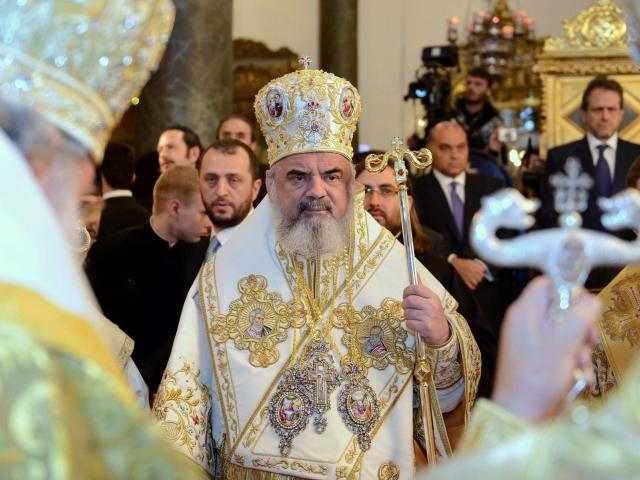
Wednesday night His Beatitude Patriarch Daniel arrived in Istanbul accompanied by His Eminence Metropolitan Iosif of Western and Southern Europe Metropolitanate, His Eminence Metropolitan Nifon, Archbishop of Targoviste and Patriarchal Exarch, Patriarchal Counsellors Michael Tita and Stefan Ababei and deacon Mihai Musat.
The Synaxis began Thursday, 6 March 2014, with a Te Deum service, while the working session was opened by His Holiness Bartholomew, Ecumenical Patriarch, who emphasised the need to organise meetings with the Primates of the Orthodox Churches in order to confess together the unity of faith and meet the issues of the contemporary society. All the Primates present delivered speeches of salute. The speech of His Beatitude Patriarch Daniel was entitled “Pan-Orthodox Synaxis – a representative spiritual event”, out of which we render a fragment below:
The Synaxis or meeting of the Primates of the Autocephalous Orthodox Churches is not a permanent institution, but a spiritual representative event. The pan-Orthodox Synaxis of Primates has neither formal status, nor competences expressed in canonical juridical terms. It is not a Pan-Orthodox Synod, but a pan-Orthodox representation of the autocephalous synods, presided over by the Primates present in the Synaxis.
The pan-Orthodox Synaxis has at present a consultative and orientating role in order to strengthen the sacramental communion through Eucharistic concelebration, pastoral co-responsibility through dialogue and missionary cooperation through action, among the Autocephalous Orthodox Churches and in the relations of Orthodoxy with the world of today. The spiritual authority of the Synaxis increases mostly by promoting co-responsibility for the unity of Orthodoxy.
At present, more consultation and cooperation among the sister Orthodox Churches is needed, in front of three major challenges facing the world today:
1.secularism or religious indifferentism, which negatively affects the traditional Orthodox family, the Orthodox parish, the Orthodox monastery and the Orthodox mission in society;
2.migration phenomenon, which generates new social and pastoral problems, especially when migration is caused by war or persecutions, as it can be seen today in Syria and in other parts of the world;
3.economic and financial crisis, which calls us to greater solidarity with the poor, the sick and the lonely ones.
Friday, 7 March 2014, the second day of the session, proposals for the organisation and good development of the Holy Great Pan-Orthodox Synod were presented. To end with the day, the delegations participated in the Annunciation Akathistos celebrated in the church of “Saints Michael and Gabriel the Archangels” situated on the left bank of the Bosporus, celebrated by His Beatitude Teodor II, Patriarch of Alexandria and All Africa.
Saturday, 8 March 2014, the third day, the Patriarchs and Primates of the Orthodox Churches visited the “Healing Spring” Monastery where it is the cemetery where most of the patriarchs of Constantinople are buried. His Beatitude Patriarch Daniel and the accompanying delegation prayed at the graves of the former ecumenical patriarchs who had important relations with the Romanian countries and with the Romanian Orthodox Church.
Saturday night, in the end of the Synaxis, the document comprising the conclusions of the meeting was signed.
On 9 March 2014, Orthodoxy Sunday, the Primates celebrated the Divine Liturgy in the Cathedral of “Saint Great Martyr George” of the Ecumenical Patriarchate. They celebrated together, sanctifying through the Holy Mysteries administrated the dogmatic and liturgical unity in whose name Saturday night they signed the final document of the Synaxis.
To end with, a Trisaghion was celebrated for all the Orthodox patriarchs passed away in the course of time. The Primates participated in the traditional procession of the holy icons organised every year at the Ecumenical Patriarchate on the Orthodoxy Sunday.
The visit of His Beatitude Patriarch Daniel to the old city of Constantinople ended Sunday night, when His Beatitude visited the faithful of the Romanian Orthodox parish of “Saint Paraschevi” of Istanbul. The Primate of our Church remembered in the speech delivered the support that the Ecumenical Patriarch Bartholomew granted to the Romanians over here. The church of the Romanians of Istanbul was founded by the Saint Prince Constantine Brancoveanu.
“This year is the year of the Brancovean Saints in the Romanian Patriarchate and this is why we offered His Holiness, the Ecumenical Patriarch, an icon of the Brancovean Saints as a sign of thanksgiving for having given us the possibility to have here a place of liturgical service for the Romanian Orthodox community. His Holiness is very generous and understood the importance of the pastoral service of the Orthodox Christians and of those of other ethnic origin too who live in this city, Istanbul”, His Beatitude said.
The Patriarch of Romania offered Rev Vlad Sergiu, priest of the Romanian community of Istanbul, as a sign of appreciation, the medal of the commemorative year of the Brancovean Saints Martyrs and of the Eucharistic year in the Romanian Patriarchate, as well as several books published within the Romanian Patriarchate.
Protected by “Saint Martyr Paraschevi”, the church is situated on the Eastern bank of the “Golden Horn” gulf. A text on the Eastern side of the place of worship mentions the restoration of the church from the foundation made with the help of the donation of the Saint Ruling Prince and Martyr Constantine Brancoveanu, in 1692.