St. Paul the Confessor
Saint Paul the Confessor, Archbishop of Constantinople, was chosen to the patriarchal throne after the death of Patriarch Alexander (+ 340), when the Arian heresy had again flared up. Many of the Arians were present at the Council which selected the new Archbishop of Constantinople. They revolted in opposition to the choice of Saint Paul, but the Orthodox at the Council were in the majority.
The emperor Constantius, ruling over the Eastern half of the Roman Empire, was an Arian. He was not in Constantinople for the election of the Archbishop, and so it took place without his consent. Upon his return, he convened a council which illegally deposed Saint Paul, and the emperor banished him from the capital. In place of the saint they elevated Eusebius of Nicomedia, an impious heretic. Archbishop Paul withdrew to Rome, where other Orthodox bishops were also banished by Eusebius.
Eusebius did not rule the Church of Constantinople for long. When he died, Saint Paul returned to Constantinople, and was greeted by his flock with love. But Constantius exiled the saint a second time, and so he returned to Rome. The Western emperor Constans wrote a harsh letter to his Eastern co-ruler, which he sent to Constantinople along with the holy exiled archpastor. The threats worked, and Saint Paul was reinstated upon the archepiscopal throne.
But soon the pious emperor Constans, a defender of the Orthodox, was treacherously murdered during a palace coup. They again banished Saint Paul from Constantinople and this time sent him off in exile to Armenia, to the city of Cucusus, where he endured a martyr’s death.
When the Archbishop was celebrating the Divine Liturgy, Arians rushed upon him by force and strangled him with his own omophorion. This occurred in the year 350. In 381, the holy Emperor Theodosius the Great solemnly transferred the relics of Saint Paul the Confessor from Cucusus to Constantinople. In 1326, the relics of Saint Paul were transferred to Venice.
Saint Athanasius the Great, a contemporary of Saint Paul, writes briefly about his exiles, “Saint Paul the first time was sent by Constantine to Pontus, the second time he was fettered with chains by Constantius, and then he was locked up in Mesopotamian Syngara and from there moved to Emesus, and the fourth time to Cappadocian Cucusus in the Taurian wilderness.”

Troparion, tone 3:
Your confession of the divine Faith, / has shown you to the Church as another Paul, and a zealot among priests; / the righteous blood of Abel and Zachariah cries out to the Lord with yours. / O Righteous Father, / entreat Christ God to grant us great mercy.
St. Luke, monk, of Sicily
Saint Luke of Sicily was a native of the Sicilian city of Tauromenium. In his youth he left his parents and fiancée and went into the wilderness, where he spent many years in fasting and prayer. He lived the ascetic life at Mount Aetna.
Towards the end of his life Saint Luke, because of a revelation to him, founded a monastery. In order to become familiar with the rule and life of other monasteries, he visited many other cities. He died at Corinth in 820.
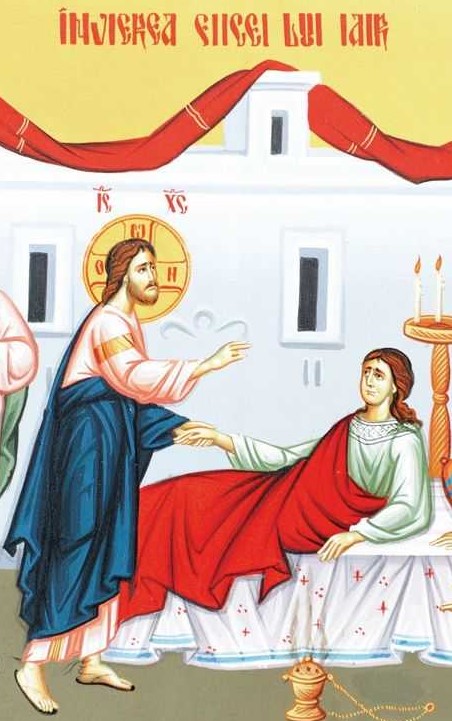
24th Sunday after Pentecost (Resurrection of Jairus’ daughter)
Gosepl – Luke 8:41-56:
And behold, there came a man named Jairus, and he was a ruler of the synagogue. And he fell down at Jesus’ feet and begged Him to come to his house, for he had an only daughter about twelve years of age, and she was dying.
But as He went, the multitudes thronged Him. Now a woman, having a flow of blood for twelve years, who had spent all her livelihood on physicians and could not be healed by any, came from behind and touched the border of His garment. And immediately her flow of blood stopped. And Jesus said, “Who touched Me?” When all denied it, Peter and those with him said, “Master, the multitudes throng and press You, and You say, ‘Who touched Me?’” But Jesus said, “Somebody touched Me, for I perceived power going out from Me.” Now when the woman saw that she was not hidden, she came trembling; and falling down before Him, she declared to Him in the presence of all the people the reason she had touched Him and how she was healed immediately. And He said to her, “Daughter, be of good cheer; your faith has made you well. Go in peace.”
While He was still speaking, someone came from the ruler of the synagogue’s house, saying to him, “Your daughter is dead. Do not trouble the Teacher.” But when Jesus heard it, He answered him, saying, “Do not be afraid; only believe, and she will be made well.” When He came into the house, He permitted no one to go in except Peter, James, and John, and the father and mother of the girl. Now all wept and mourned for her; but He said, “Do not weep; she is not dead, but sleeping.” And they ridiculed Him, knowing that she was dead.
But He put them all outside, took her by the hand and called, saying, “Little girl, arise.” Then her spirit returned, and she arose immediately. And He commanded that she be given something to eat. And her parents were astonished, but He charged them to tell no one what had happened.